Simulations & decision preparation
Put your strategies to the test.
Whaydon designs and runs strategic simulations for armed forces, industrial companies and their partners. The aim: test your assumptions before reality does it for you.
The problem
A plan is never played alone.
A production ramp-up depends on a supplier, a funder, a prime contractor. Each has its own constraints and interests, rarely visible in the plan.
Organisations often discover their dependencies when these turn into a crisis. A simulation brings them out beforehand, at limited cost, in a setting where mistakes are allowed.
How we work
Test, confront, replay.
- 01
Test internally
Your team plays on its own first: assumptions, reflexes and dependencies become visible before they meet other actors.
- 02
Confront the actors
The roles of your partners are played by participants or by simulated actors, flagged as such, to explore their constraints and commitments.
- 03
Replay and adjust
The debrief explains the consequences of choices; the replay lets you compare options and prepare what follows.
Deliverables
What you get.
- A scenario built around your challenge and its actors
- One or several facilitated sessions, with replay
- A written debrief: assumptions tested, points of dependency, options compared
- Next steps: trade-offs to prepare, discussions to open with partners
Example
When a supplier’s lead time changes.
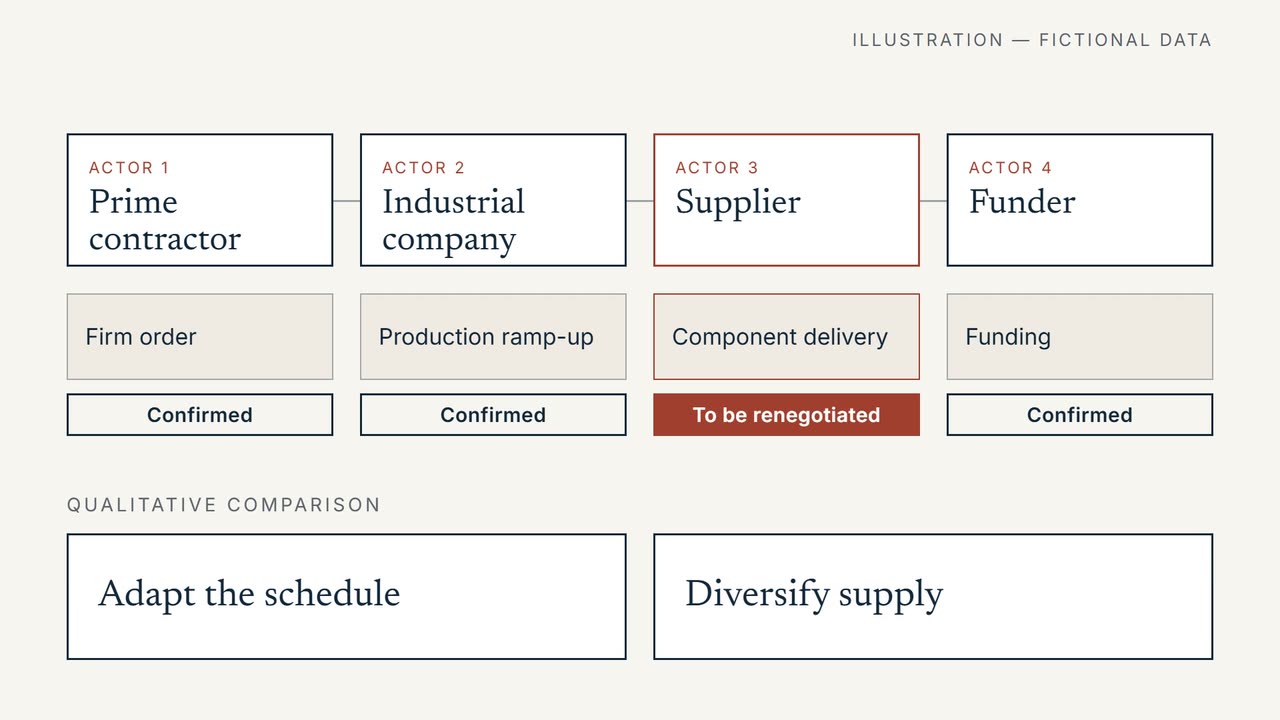
A prime contractor, an industrial company, a supplier and a funder. The supplier revises its lead time. A commitment moves from “to be confirmed” to “to be renegotiated”. The team compares two options, with no performance figures: adapt the schedule or diversify supply.
Illustration of method, fictional data.
Transcript
- 0–5 s Illustration: a working session brings industry and defence professionals around a table.
- 5–12 s Four actors: prime contractor, industrial company, supplier, funder, and their commitments. One disruption appears: supplier lead time revised.
- 12–17 s A commitment moves from “to be confirmed” to “to be renegotiated”. Two qualitative options are compared: adapt the schedule or diversify supply.
- 17–20 s Whaydon. Test. Confront. Adjust.
The examples (production ramp-up, support and maintenance, failure of a critical supplier, coordination between prime contractor, SMEs and funders) are illustrative. A simulation sheds light on choices; it does not predict real behaviour.