Structure information
Link documents, assumptions, activities, responsibilities and indicators.
Strategy, simulation & project delivery.
Whaydon supports armed forces, industrial companies and international cooperation actors by combining field expertise, software tools and artificial intelligence.
We work withArmed forces · Industry · International organisations · Bilateral agencies
I — Simulations & decision preparation
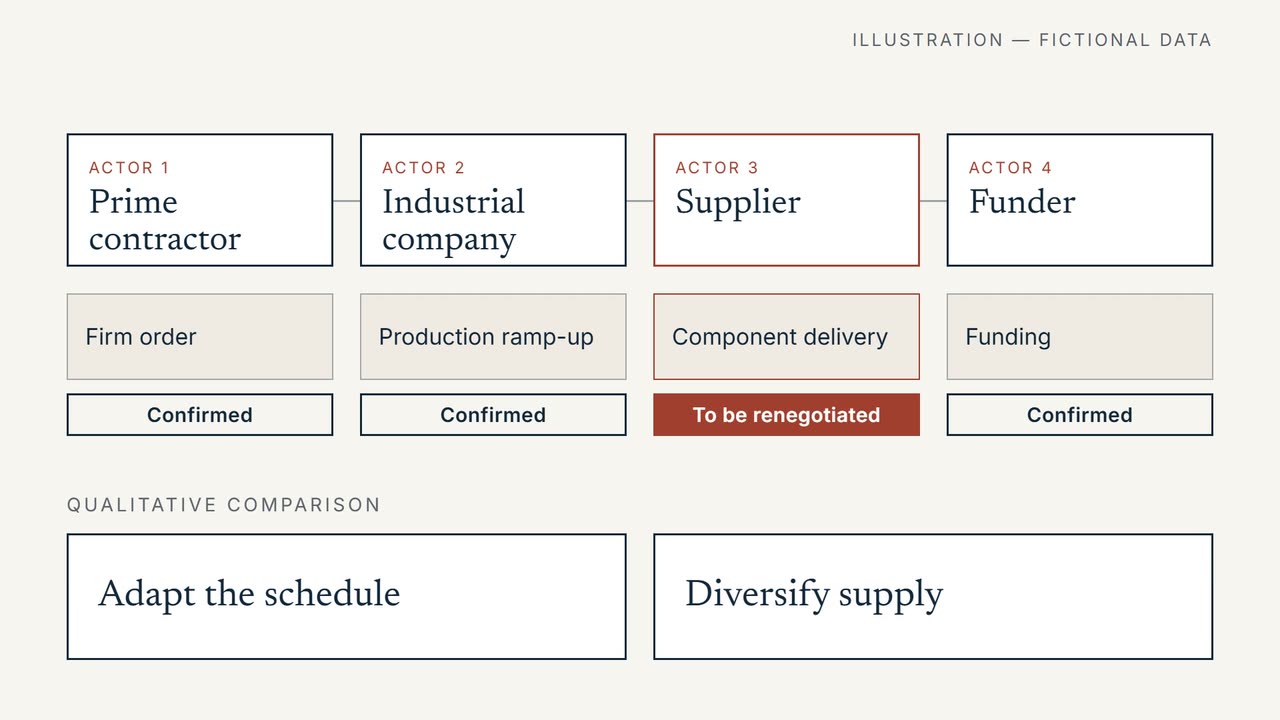
A plan also depends on the decisions of those you do not control. Whaydon designs simulations to test your assumptions, bring conflicting interests into play and prepare your trade-offs with the actors of your ecosystem.
Three steps
Illustrative examples
A simulation sheds light on possible choices: it does not predict real behaviour and does not validate an operational capability. Where AI plays certain roles, these simulated actors are clearly distinguished from human participants.
II — Strategy & project delivery
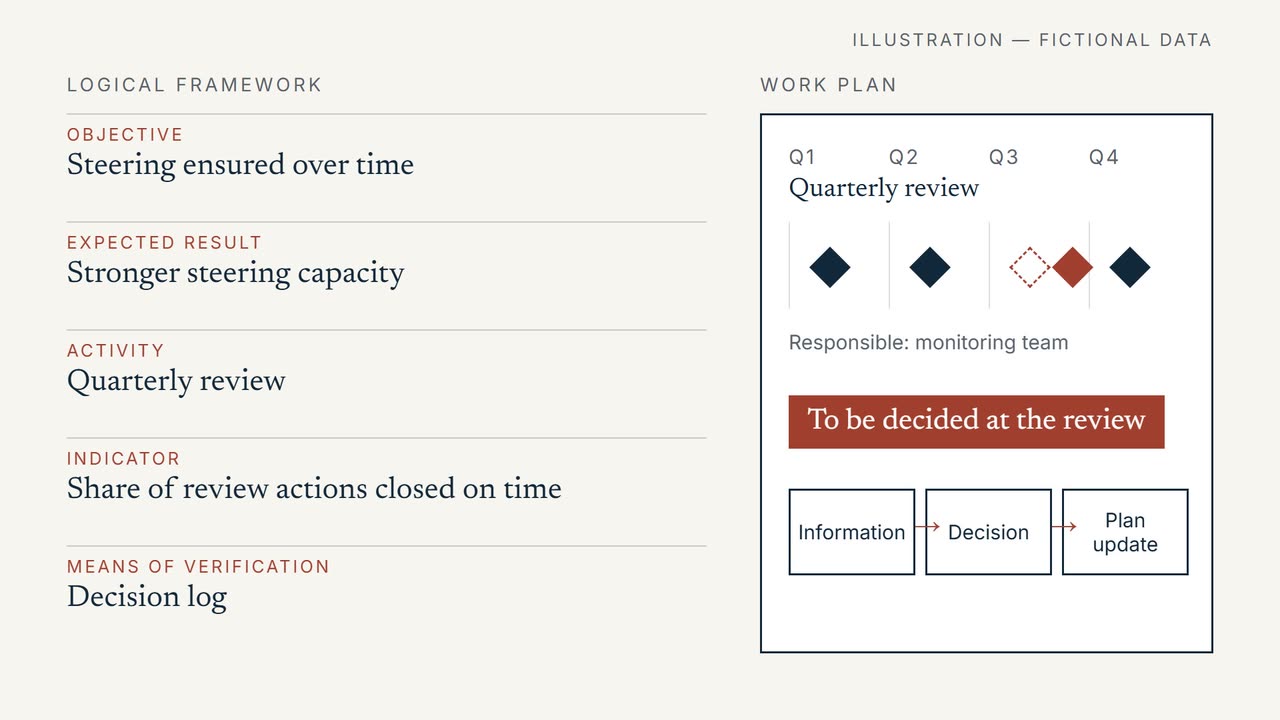
Whaydon supports international organisations, bilateral agencies and their partners in the design, implementation and monitoring of their interventions. Strategy, logical frameworks, work plans and monitoring and evaluation rely on tools suited to your teams and your field conditions.
Four dimensions of a mission
We design and adapt software tools, including AI, to connect these elements, make them easier to keep up to date and support the work of teams. How they are used is defined according to the mission, connectivity and the client’s technical environment.
Illustrative example
A priority changes. Which expected results, activities, indicators and deadlines need to be reviewed? Who must decide, and on what information?
The tools mentioned are under development or offered as supported pilots, depending on the mission. Their availability is made clear before any commitment.
Software & AI
Link documents, assumptions, activities, responsibilities and indicators.
Spot inconsistencies, prepare syntheses and bring out the questions that need a decision.
Find sources, decisions, changes and items to be revisited.
Subject-matter expertise and human validation frame every use of AI: it prepares and flags, teams decide.
Online tool, usable offline or integrated into the client’s environment: this is settled when the mission is scoped, according to the requirements and the capabilities actually available.
Maturity. Tools are described at their actual level: available, supported pilot or under development. No feature is announced before it exists.
Ways of working
Diagnosis, design of a mechanism, project review or pilot exercise.
Support to teams, steering tools, periodic reviews and adjustments.
Successive sessions, confrontation of actors and replay.
Custom development is identified as such. Licences and stand-alone offers are only proposed once a product and its terms of use exist.
Track record & team
Whaydon draws on the experience of its founder, Julien Serre, in international organisations, development finance and defence, and on a network of experts assembled mission by mission.
Illustration. The examples on this site are illustrations of method, built on fictional data. They describe neither a client nor an actual mission.
Julien Serre, President of Whaydon, and the firm’s network of experts.
Analysis & publications
2025 shook the business of forecasting. Julien Serre nonetheless ventures ten scenarios for 2026, from the improbable to the inevitable — from Ukraine at the gates of the European Union to Nefertiti’s return to Cairo.
The Omnibus proposals unveiled by the European Commission create unprecedented opportunities for French SMEs to support the Union’s defence effort.
In a world saturated with data and governed by immediate performance indicators, the temptation is strong to favour the measurable over the relevant. Yet the experience of large industrial companies shows that it is sometimes — not always, but noticeably — weak signals that prefigure the real turning points.