Foresight in international organisations: what can they learn from large corporations?
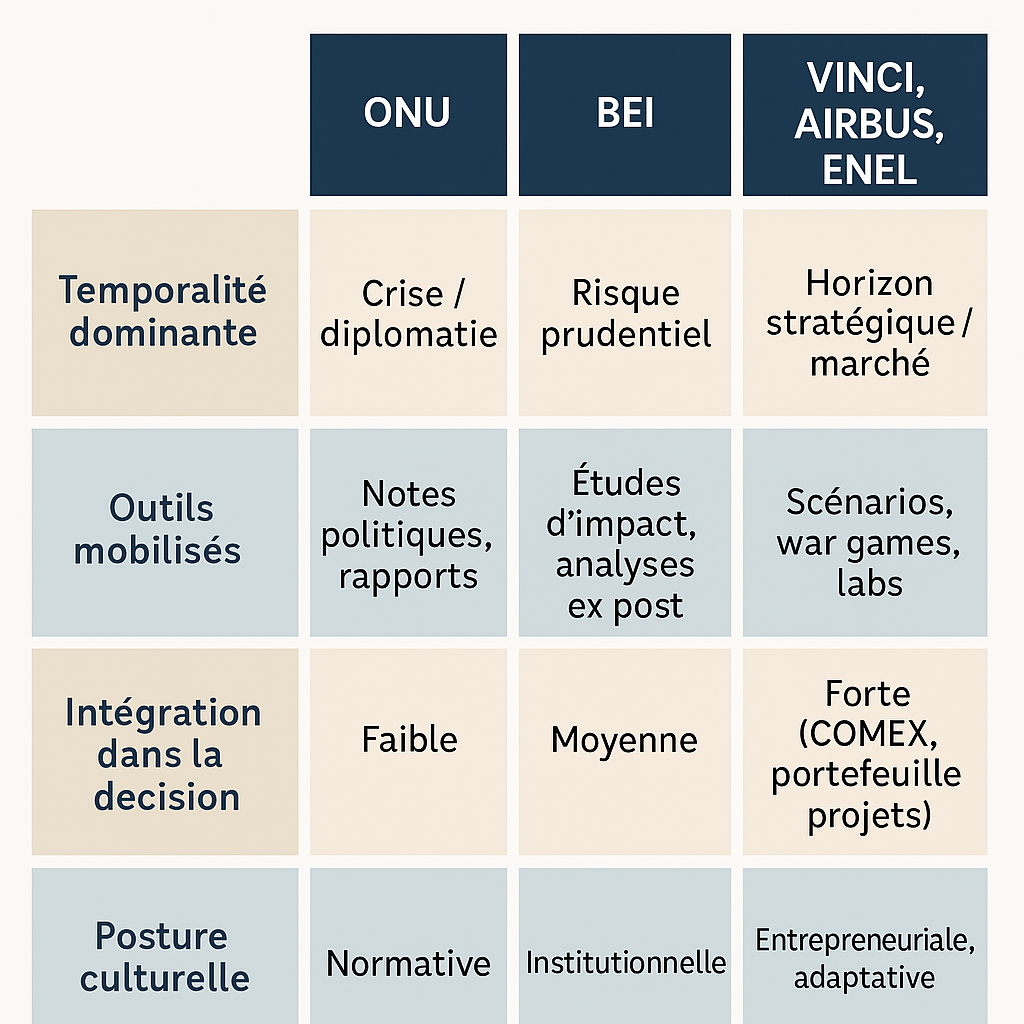
Large corporations have professionalised the way they analyse possible futures. International organisations, long seen as the guardians of stability, sometimes struggle to absorb that same requirement for rapid transformation.
Yet whether at the United Nations or at the European Investment Bank, the challenges are similar: steering under uncertainty, geopolitical fragmentation, climate transition, technological rupture, pressure on resources. So why does the gap seem to be widening in how public institutions and large private groups mobilise foresight?
The UN: fragmented and under-capitalised foresight
The UN system has recognised foresight since the 1970s. UNDP and the World Food Programme were early movers. Yet in 2024 foresight remains fragmented, scattered between UNDP, the Secretariat and the specialised agencies. Global Pulse and the work of the UN75 Policy and Foresight Unit have not established a durable culture of strategic scenario-building. The UN remains focused on responding to immediate crises. Its tempo is still dominated by short-term politics, budget windows and diplomatic consensus.
Lessons to draw:
- Structure a continuous, inter-agency approach, aligned with the main decision functions — Secretary-General, Security Council, ECOSOC;
- Build mixed teams — analysts, technologists, field practitioners — to anchor foresight in reality;
- Dare a disruptive scenario approach, including on the limits of multilateralism.
The EIB: between risk engineering and strategic hesitation
The European Investment Bank has developed tools for assessing long-term risk — climate, sustainability, industrial value chains. Its 2030 climate strategy and its support for the European Green Deal both contain foresight elements. The Bank still needs to move beyond a linear model: analyse, finance, control. Strategic risk-taking — particularly if it is asked to do more for European defence — should not be excessively constrained by governance. And foresight, often delegated to external consultants, will have to be brought in-house.
Lessons to draw:
- Move from compliance to transformation: embed foresight in capital allocation and in the dialogue with clients;
- Formalise an internal foresight unit attached to strategic planning;
- Adopt more dynamic tools: simulations, war games, rupture mapping.
VINCI, Airbus, Enel: three models of strategic anticipation
VINCI, through its Leonard programme, created a structure dedicated to foresight and open innovation. It combines community building, incubation, scenarios and long-term strategic reflection — working on cities, hydrogen and infrastructure resilience, with a capacity to translate weak signals into roadmaps.
Airbus, with its future divisions (UpNext, Blue Sky) and its Strategic Foresight Lab, develops long-term technological, geopolitical and climate scenarios integrated into industrial strategy. The company runs military foresight exercises on future combat systems and industrial stress tests.
Enel, a key energy player, has embedded strong foresight in its strategic steering through a Scenario Planning Office. It structures its portfolio around energy transition scenarios, carbon regulation trajectories and shifting patterns of use, using internal modelling tools to inform investments out to 2040.
Conclusion: learning agility without betraying the mission
International organisations should not imitate corporations. Their mission, their constraints and their legitimacy are specific. But three major lessons hold:
- Institutionalise foresight, embedding it in the decision cycle rather than appending it as an annex.
- Dare uncomfortable hypotheses, including about their own role in a changing world.
- Invest in cross-cutting work, creating shared spaces between data, geopolitics, technology and the field.