From monitoring to roadmap: building foresight that executive committees can use
In large French industrial companies — whether in energy, infrastructure, aerospace or defence — foresight often remains confined to monitoring: a stream of annotated information, a radar of trends, a library of weak signals. That is useful. It is not sufficient.
Faced with geopolitical upheaval, supply tensions, the emergence of impressive AI systems and climate transformation, the time has come for decision-grade foresight: foresight that does not merely observe the world but equips executive committees to arbitrate, steer, invest and divest.
Moving from monitoring to roadmap requires a deep change of posture.
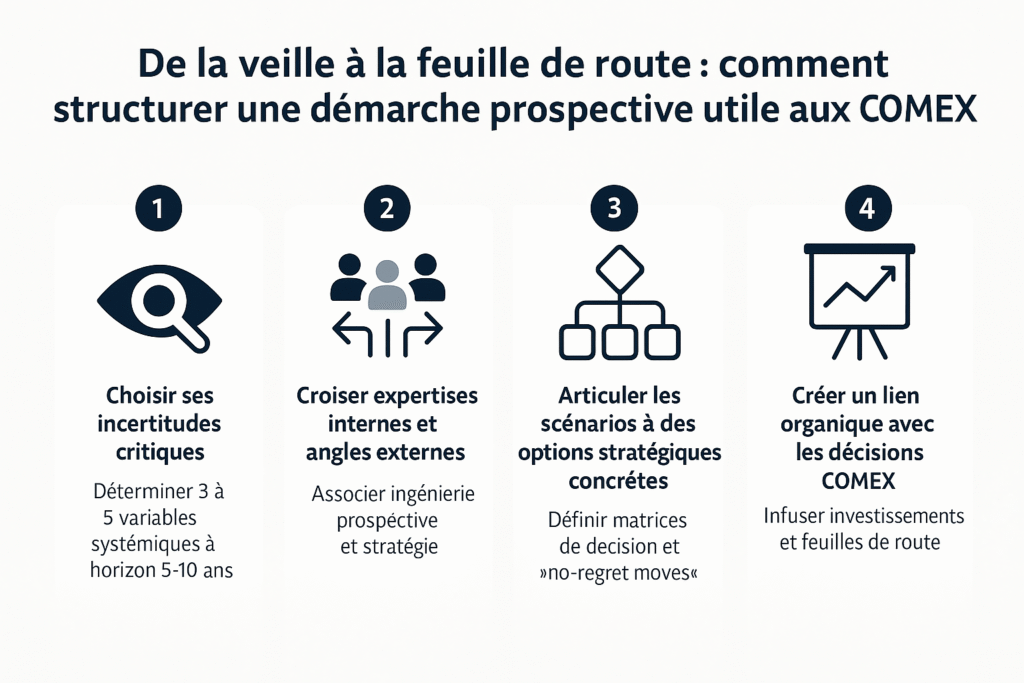
- Choose your critical uncertainties. The point is not to track everything, but to identify the three to five systemic variables that will shape the core of the business model over five years. Why not ten? Because ten is already too far, given the transformations under way.
- Cross internal expertise with external angles. Engineers know what is feasible. Foresight practitioners challenge what is thinkable. Corporate strategists arbitrate what is sustainable. The future is co-constructed in that triangulation. Heated discussion is inevitable — and, better still, desirable.
- Tie scenarios to concrete strategic options. A scenario without a lever for action is a novel. What counts is being able to say: if scenario X is confirmed, we will do A, B or C. That requires shared decision matrices, no-regret moves, and bets that are owned as such. It also requires knowing when to abandon a dead horse.
- Create an organic link with executive decisions. Foresight must not be a parallel production. It has to permeate investment decisions, technology roadmaps and workforce trajectories. Only then does it become a political and managerial asset. This holds as much for a CAC 40 company as for an international cooperation institution.
In recent work on industrial transformation — particularly in critical or regulated sectors — one observation stands out: effective foresight depends neither on budget nor on tools, but on the level of strategic trust granted to the exercise. When it is carried at the highest level, with rigour, it becomes what it should be: a lead-time advantage.
Good foresight is not the kind that reassures. It is the kind that lets you act before the others.